A Wedding, a Market and the Leica M10-D

Updated: Aug 17
Leica M10-D + Voigtlander Color-Skopar 50mm f2.2: A Field Review
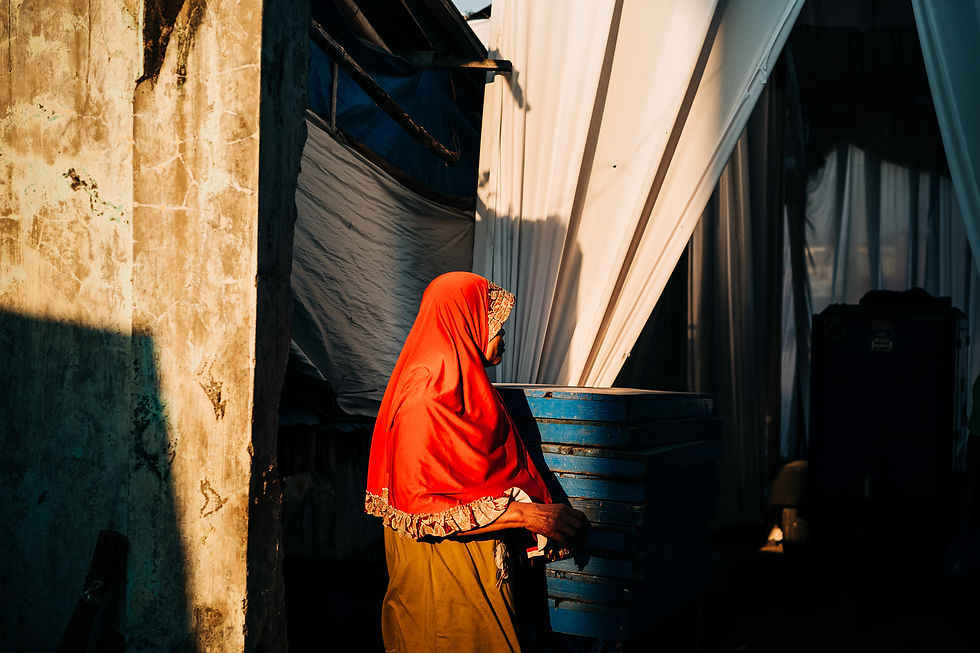
Several weeks ago, I had the privilege of attending a wedding in Semarang, Indonesia. The trip embodied two days photographing the wedding, and one morning wandering a local market.
My travel kit of choice was my Leica M10-D and the Voigtlander Color-Skopar 50mm f2.2. A unobtrusive camera kit which harkens to a time when photojournalists roamed the world documenting exotic locales with their Leica rangefinders.

Leica's Most Analog Digital
Manufacturer page: https://leica-camera.com/en-US/product/leica-m10-d-black-chrome
In the late nineties and early two-thousands, I photographed with a Leica M6 extensively alongside my Nikons while working as a profesisonal photographer.
When the M10-D was first released in 2018, it felt like Leica was speaking directly to me — no screen, no extra buttons, all the simplicity that I loved about a Leica M film body but with all the convenience of a digital workflow underneath.
And yet, one detail kept me from buying the camera for years: the film-advance lever that doesn't actually do anything. At that time, this detail was a design which I couldn’t understand or accept.
It took me several years with other Leica digital M and Q cameras to understand that the lever really did create a better place to rest my thumb and the M10-D feels more at home in the hand because of it. Most digital M & Q owners invariably end up buying a thumb support. I’ve come to appreciate the ergonomics of the thumb lever on the M10-D and how it folds away to maintain the original lines of the camera.
While I’m not a collector and know nothing about collecting about cameras, I do have a feeling that the M10-D will eventually become one of the few collectible digital cameras from Leica because of this thumb lever. It’s a design feature that I seriously doubt we will likely see again on a digital M.
Beyond the nostalgia, I purchased the camera knowing I wanted a step back from using cameras that had become too screen centric. However, I was 100% sure I didn't want to return to the cost and hassle of developing and scanning film, especially with the astronomical price of film and developing these days.
I've come to believe the right camera finds you when you're ready for it, not necessarily when it's released — and this one found me a little late, but at exactly the right moment.
For photographers that just want the most capable tool available, I'd steer elsewhere. In a world filled with super fast autofocus, mind bending frame rates, subject detection and sub menus deep enough to deserve its own search function, the Leica M10-D is extremely constrained by modern standards. This is exactly why I love it.


Form Follows Process
Without a screen, photographers have to make peace with an image the moment they make it. That single absence reorders everything — I find myself reading light direction, intensity and color before I raise the camera, forcing me to focus on the process of creating the image instead of the final output.
Form follows process when using this camera. For photographers used to chimping as a means of checking the final image, the option to retreat or take a little pause from the scene in front, take that away and there's nowhere left to go but further into the moment.
The camera body is small enough and retro looking enough that people mostly forget I'm there. I feel like I can move through a crowd or slip to a new angle without feeling like I'm carrying a barrier between myself and life happening in front of me.


Drawbacks
Even though I love this camera, it’s not without its faults.
• Battery life is modest — I burned through about three batteries over a full wedding day. Be prepared to carry spare batteries. Thankfully there are now third party ones available for the M10 series
• Exposure compensation is assigned to a hard to spin rear dial rather than the more intuitive dial under my thumb, which made it genuinely hard to adjust quickly — especially moving between indoor and outdoor light mid-event. I've heard the M11-D fixes this.
• The beauty of shooting the M series fo film cameras was the clean, uncluttered viewfinder, Two arrows and a dot was all there was. The M10-Ds viewfinder provides more data like exposure compensaiton and shutter speed, detracting a little from the analog experience.
• Changing a battery means removing the entire bottom plate, which gets old fast if it’s rainy or I’m in a precarious place where I could lose the plate.
• The external EVF drains the battery fast enough that I can't just leave it mounted. If I want to use it for a 21mm or a 90mm, I end up attaching and detaching it right along with the lens swap. Furthmore the Leica EVF 2, originally made for this camera, doesn't project an image sharp enough to focus is without zoooming and the focus peaking is perpetually on with no way to turn it off. These limitations likely preclude the M10-D as a one and done camera body for most photographers.

Tips and Tricks
• The meter leans center-weighted, so my habit is: meter on the subject, lock exposure, recompose, shoot. Many reviewers have recommended underexposing by -2/3 of a stop to prevent the highlights from blowing out. While the files have a wide exposure latitude, especially towards under exposure, I’ve noticed a color shift towards magenta when the file is too underexposed. For the most part, my exposure compensation is -1/3 or 0.
• In mixed light — stepping from indoors to out — I try to think a step ahead because the compensation dial isn't conducive for split-second changes.
• To keep the slim profile of the camera and yet maintain a comfortable grip on it, I’ve added grip tape to where my thumb and middle finger rests instead of buying an external grip for the camera.

Voigtlander 50mm F2.2
Manufacturer page: https://www.voigtlaender.de/lenses/vm/50-mm-12-2-color-skopar/?lang=en
The Color-Skopar 50mm f2.2 is one of the smallest 50mms you can put on an M-mount, smaller even than the compact Summicron and a fraction of the price of most Leica glass. Paired with the M10-D, it turned my whole kit into something I could carry all day without noticing the weight — which mattered on a trip where I was going to be out and about for the day.
It's not a lens many people talk about, but I think it's one of the real hidden gems in the Voigtlander lineup.

How It Performed
It renders like a modern lens — sharp, contrasty, more saturated than I expected and remarkably resistant to flare. The out-of-focus areas are smooth rather than distinctive. This isn't a lens I'd reach for if I wanted a character lens.
Focusing on a rangefinder, the lens felt fast with a relatively short throw. The build quality feels on par with the Leica glass I’ve owned in the past. The aperture ring clicks cleanly.
I'll admit the small focus ring can feel a little fussy in bigger hands — I noticed it myself when I mounted the lens on my Leica SL2s, where a larger 50mm actually balances better. On the M-series, or any small digital body, that same compactness is exactly what makes it sing and a perfect size for other small camera bodies such as the Fuji XE-5.


Go Anywhere
I'd recommend this lens to any travel or street photographer who values a light bag over a lens with a signature look. The performance is genuinely excellent. Sharp, clean and modern. If you're chasing a particular optical character, or a vintage lens look this isn't your lens.

Geography and Focal Lengths
A little discussed but relevant topic when it comes to travel and street photography is choosing the right focal lenght for a certain part of the world.
While I find 50mm is perfectly suitable as a street lens in North America, in the tighter cities of Asia and Europe, the lens felt more suited towards portraits or subject isolation without the distance to back up. If I had the chance to do over, I'd probably use a 28mm or 35mm as a staple lens for urban Asia instead of a 50mm.


Closing Thoughts
In today's world where there is almost no bad modern camera or lens, my equipment philosophy is that I need to make the distinction if the camera contributes to my technical capabilities or my user experience or both.
The M10-D and the Color-Skopar 50mm f2.2 gave me a small, quiet way to move through both a wedding and a morning of street photography in Semarang without the camera ever getting between me and my subjects. The camera asked me to be patient and present in exchange for that freedom.
The lens simply did its job in a package I barely noticed I was carrying. I think anyone with a film background, or anyone who's craving a slower, more deliberate way of making pictures, would feel at home with this pairing.
On this trip, the M10-D fulfilled those childhood dreams of being a globe trotting National Geographic photographer with a Leica M in hand. As such, it places this camera and lens combination squarely in the camp of the user experience.

Comments